

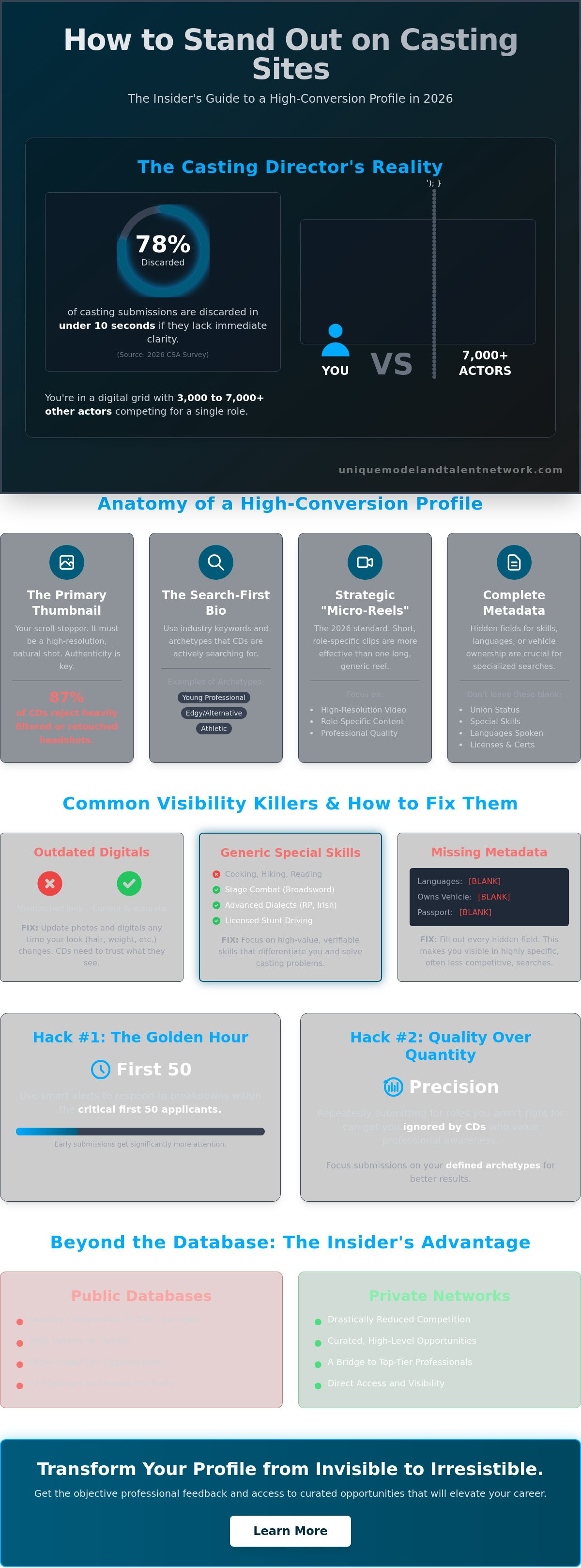
According to a 2026 survey by the Casting Society of America, 78% of casting professionals discard submissions within just 10 seconds if the materials lack immediate clarity. If you've been paying for multiple premium memberships only to feel invisible, you aren't alone. It's exhausting to compete with 7,000 other actors for a single role while wondering if anyone is even clicking your name. Mastering how to stand out on casting sites requires more than just uploading a headshot. It requires a strategic, business-first approach to your digital presence.
You deserve a profile that works as hard as you do. We're sharing the high-conversion strategies used by industry insiders to transform your casting profiles from invisible to irresistible. You'll learn which media elements actually drive bookings, how to optimize for the new AI-driven sifting tools, and why authenticity is your greatest asset in a saturated market. This guide provides the clarity you need to stop guessing and start securing more audition requests.
Key Takeaways
- Understand the "First Five Seconds" rule to ensure your profile stops the scroll on a casting director's crowded dashboard.
- Master how to stand out on casting sites by optimizing your primary thumbnail and using industry-standard archetypes in your searchable bio.
- Learn why role-specific "micro-reels" and high-resolution headshots are the 2026 standard for closing the deal with top-tier professionals.
- Secure your spot in the "Golden Hour" by using smart alerts to respond to breakdowns within the critical first 50 applicants.
- Discover how private networks provide a bridge to high-level opportunities without the competition and noise of public databases.
The 'Black Hole' Problem: Why Most Casting Profiles Are Invisible
When you submit for a guest star role on a network procedural, you aren't just competing with the actors in your acting class. You're competing with a digital grid that can contain upwards of 3,000 submissions for a single spot. To a Casting Director (CD), your professional identity is reduced to a tiny thumbnail on a crowded dashboard. If your profile doesn't immediately signal "solution" within the first five seconds, the CD will move to the next row without ever clicking your name. This snap judgment happens before they see your training or your credits.
Many actors believe that having a 100% complete profile is a competitive advantage. In reality, a completed profile is simply the price of entry. To truly understand how to stand out on casting sites, you must undergo a psychological shift. Stop treating your profile as a static resume of past achievements. Instead, view it as a high-conversion business storefront designed to sell a specific product: your current look and professional capability. If your storefront is cluttered or outdated, the customer will keep walking.
The CD Filtering Process
The Casting (performing arts) process relies heavily on efficiency. CDs use powerful database filters to instantly narrow down thousands of applicants to a manageable "Selects" list. They filter by specific physical traits, union status, and geographic location. If you haven't optimized your profile for these search parameters, you're effectively invisible. However, avoid the temptation to over-submit for roles that don't fit your current archetype. If you repeatedly appear in searches for roles you aren't right for, you risk being ignored by CDs who value precision and professional awareness. Quality of submission always outweighs quantity.
Common Visibility Killers
Even the most talented performers can fall victim to visibility killers that keep them trapped in the "black hole." These often include:
- Missing Metadata: Hidden fields for specific skills, languages, or vehicle ownership are often left blank. This excludes you from specialized searches that could lead to direct bookings.
- Outdated Digitals: If your current hair length or weight doesn't match your uploaded "look-specific" shots, CDs won't trust your profile for immediate bookings. They need to know the person who walks on set is the person in the photo.
- Generic Special Skills: Listing "cooking" or "hiking" doesn't differentiate you. Focus on high-value, verifiable skills like "stage combat," "advanced dialects," or "licensed stunt driving."
By identifying these gaps, you move from being a passive participant to an active manager of your career. Mastering how to stand out on casting sites is about ensuring that when a CD sifts through the noise, your profile provides the clarity and professional standards they require to take the next step.
The Anatomy of a High-Conversion Profile in 2026
If you want to understand how to stand out on casting sites, you must first master the visual entry point. Your primary thumbnail is the only asset that matters until a click occurs. According to a January 2026 survey by the Casting Society of America, 87% of casting professionals now reject headshots that appear heavily filtered or retouched. They want to see the person who will actually walk onto the set. Your thumbnail should be a high-resolution, natural representation of your most bookable look. It's the scroll-stopper that transitions you from a grid of faces to a serious candidate.
Once the click happens, your bio must sustain that momentum. A high-conversion bio is search-first; it uses the specific vocabulary that casting directors type into their search bars. Instead of writing a narrative story about your childhood dreams, focus on industry-standard terminology. Use keywords that define your current professional placement. If you're unsure if your bio hits these marks, a Portfolio & Reel Review can provide the objective professional feedback needed to sharpen your presentation and increase your visibility.
The Power of Archetypes
Casting directors in 2026 are looking for specificity. They need to know exactly where you fit into their story within seconds. By defining yourself through archetypes like "Young Professional," "Edgy/Alternative," or "Athletic," you make their job easier. In 2026, the rise of the decipherable actor is a dominant trend; those who clearly market their specific type are more likely to be matched by AI-driven sifting tools looking for precise character fits.
Optimizing the 'Special Skills' Section
Generic skills are a wasted opportunity. Listing swimming or driving provides no competitive advantage because thousands of other applicants do the same. However, listing Advanced Scuba Certified or Manual Transmission Stunt Driving acts as a backdoor into the room. To maximize this section, attach 15-second skill clips to your profile. Seeing you actually play the cello or perform a martial arts sequence removes all doubt from the CD's mind. It's a tangible way to prove your professional value before the audition even begins.
Consistency is the final pillar of a professional profile. Your statistics, from height and weight to union status, must be identical across every platform you use. Discrepancies between different casting databases create confusion and signal a lack of professional organization. When your data is standardized and your materials are targeted, you stop being a random applicant and start being a professional solution. This level of discipline is exactly how to stand out on casting sites in a competitive market.
Strategic Media: Using Headshots and Reels to Close the Deal
While your profile data makes you searchable, your media is what converts a profile view into an audition request. In 2026, the technical and artistic standards for these assets have reached a new peak. High-resolution imagery and professional audio aren't just preferences; they're requirements for algorithmic visibility. If your media doesn't load instantly on a mobile device, or if it feels generic, you're missing the primary way how to stand out on casting sites today. You must treat your media like a high-performance sales deck that proves your value in seconds.
One secret weapon for boosting your search ranking is the use of Slate Shots, particularly on sites like Actors Access. A Slate Shot is a seven-second video clip attached to a specific headshot that allows the Casting Director (CD) to hear your natural voice and see your personality. Profiles with Slate Shots often rank higher in the submission grid, giving you a distinct advantage over actors who only provide static images. It's a small investment of time that yields a significant return in visibility.
The Three Essential Headshots
To maximize your booking potential, your portfolio needs to be curated rather than cluttered. CDs in
Algorithm Hacks: Timing, Keywords, and Submission Speed
The digital landscape of 2026 has turned casting into a high-speed environment where the "First In, First Out" principle dictates visibility. When a breakdown is posted, the first 60 minutes are known as the "Golden Hour." During this window, Casting Directors (CDs) are most active in sifting through the initial wave of talent. If you aren't among the first 50 applicants, your profile risks being buried under thousands of subsequent submissions. Understanding how to stand out on casting sites is as much about technical timing as it is about talent.
To secure your place in that initial batch, you must move beyond manual browsing. Set up "Smart Alerts" on every platform you use. These notifications should be filtered by your specific archetypes and locations so you can respond the moment a role goes live. Speed isn't just a convenience; it's a strategic necessity. In 2026, the correlation between submission speed and audition requests is direct; those who submit within the first hour of a breakdown see a significantly higher rate of profile views than late applicants.
Visibility is also influenced by the "Profile Refresh" trick. Platform algorithms often prioritize "recently updated" profiles in search results. You don't need to overhaul your entire portfolio every week. Simply swapping the order of your headshots or updating a single special skill can trigger a status change in the database. This small action signals to the system that your profile is active and current, often bumping you higher in the CD's search grid. If you want to ensure your technical setup is optimized for these algorithms, consider joining The Network Membership for ongoing professional guidance.
Mastering the Submission Note
When you submit, the submission note is your only chance to speak directly to the CD before they click your reel. Follow the "Two-Sentence Rule": keep it brief, relevant, and professional. Mention a specific skill that directly solves a problem mentioned in the breakdown, such as "Advanced Stage Combat certified" or "Fluent in conversational French." Avoid the "Desperation Trap" of listing every credit you've ever had. A confident, succinct note proves you understand the business side of the industry.
Understanding Platform-Specific Algorithms
Each site prioritizes talent differently. Actors Access often ranks submissions based on the presence of Slate Shots and the completeness of media. Casting Networks and Casting Frontier frequently prioritize talent based on membership tiers, such as Premium Plus or Actors Access Plus. While these tiers require a financial investment, they often provide the "search-first" placement necessary to bypass the noise of basic-tier profiles. By aligning your activity with these specific platform behaviors, you master how to stand out on casting sites regardless of the competition volume.
Beyond the Database: Why Private Networks Are the Real Insider Secret
Public casting sites are essential tools, but they're also inherently limited by their own scale. When you're one of thousands of applicants in a digital grid, even a perfectly optimized profile can occasionally get lost in the noise. This is where a 360-degree career strategy becomes vital. By combining public visibility with targeted acting industry networking, you bypass the digital gatekeepers and move into spaces where the competition is filtered and the access is direct. You stop being a data point and start being a professional peer.
Mastering how to stand out on casting sites is the necessary first step toward a professional career, but building a reputation in a private community is what sustains it. In a gated environment, you aren't just another thumbnail; you're a known professional who has been vetted by mentors and industry experts. This "vouching" system is a powerful industry currency that public databases simply cannot replicate. It provides a level of career security that relies on human connection rather than just algorithmic sorting.
The Advantage of Vetted Talent Pools
Industry professionals often prefer private networks for high-priority or hard-to-cast roles because the talent pool is already pre-screened for professional standards. When you participate in Monthly Skill-Building Challenges or Live Industry Workshops, you're doing more than practicing your craft. You're building a visible track record of discipline and engagement. Casting directors look for performers who are active and prepared. This environment shifts your focus from "applying for jobs" to "building relationships" with the people who actually make the hiring decisions.
The Unique Model & Talent Network Difference
The Network Membership provides a moderated, distraction-free space designed for professional growth rather than social validation. Unlike general social media groups, this community focuses on tangible results through Industry Expert Q&A Sessions and real-time Portfolio & Reel Reviews. You receive direct feedback on how to stand out on casting sites from the very people who review those profiles daily. This direct access removes the uncertainty that often plagues emerging talent.
If you're serious about your professional development, join a community that focuses on modeling career coaching and acting success. This high-level environment ensures that your career isn't left to the mercy of an algorithm. By combining a high-conversion public profile with private, vetted networking, you create a career path that is both secure and visible in the competitive 2026 landscape.
Take Command of Your Professional Future
Success in the 2026 casting landscape requires a shift from passive participation to active strategy. You've learned that mastering how to stand out on casting sites involves more than just a complete profile; it demands high-resolution, scroll-stopping media, precise archetype targeting, and lightning-fast submission speed. By treating your digital presence as a high-conversion storefront, you ensure that every click from a casting director moves you closer to a booking. These technical adjustments are the foundation of a modern acting career.
If you're ready to stop navigating the industry alone, it's time to step into a space designed specifically for your professional growth. We offer our members direct access to casting directors and photographers through weekly live workshops and portfolio reviews. This is a private, gated community focused on tangible professional results rather than the noise of social media vanity. Stop guessing and start booking; join the Unique Model & Talent Network today! Your career deserves the clarity and security of a vetted professional path. We're here to help you turn your talent into a sustainable, thriving business.
Frequently Asked Questions
Do I really need to pay for the 'Premium' versions of casting sites to get noticed?
Yes, premium memberships are generally necessary if you want to bypass the noise of basic-tier accounts. Sites like Casting Networks and Actors Access prioritize submissions from paid subscribers, ensuring your profile appears higher in the search grid. While a free plan lets you exist in the database, a premium subscription is a strategic business investment that provides the visibility required to compete for high-level roles in a saturated market.
What is the most important part of my casting profile?
Your primary thumbnail is the most critical element of your profile. It's the only visual asset a casting director sees before deciding to click your name. If your headshot doesn't look professional, current, and look-specific, the CD will scroll past you in seconds. Mastering how to stand out on casting sites begins with a high-resolution image that accurately represents your type and professional standards.
How often should I update my photos and reel on casting websites?
You should update your materials every six to twelve months or whenever your physical appearance changes significantly. Even small updates, like a new hair color or a 15-second skill clip, can trigger a "recently updated" status in the database. This keeps your profile active in the algorithm and ensures that casting directors are always seeing your most current and bookable version.
Can I stand out on casting sites if I don't have an agent yet?
You can absolutely book work without an agent by being proactive with self-submissions. Many co-star and commercial roles are cast directly through public databases where unrepresented talent can submit. By optimizing your profile and responding to breakdowns during the "Golden Hour," you establish a professional track record that eventually makes you more attractive to top-tier agencies looking for proven performers.
Why am I not getting any views on my media clips?
Lack of views usually stems from a weak primary thumbnail or late submission speed. If your headshot doesn't stop the scroll, the CD will never reach your media section. Additionally, if you submit after the first fifty applicants, the CD may have already found their "Selects" before reaching your profile. Focus on improving your visual hook and response time to drive more traffic to your clips.
What should I do if a casting site looks like a scam?
Protect yourself by verifying the legitimacy of any platform before sharing personal data. Legitimate sites charge subscription fees but never demand a percentage of your earnings upfront or guarantee bookings. If a site lacks verifiable industry credits or uses high-pressure sales tactics, it's likely predatory. Stick to established platforms and vetted private networks to ensure your professional safety and career security.
How do I write a submission note that actually gets read?
A successful submission note follows the "Two-Sentence Rule" by being brief and solution-oriented. Lead with a specific skill or availability that directly addresses the needs of the breakdown. Avoid generic flattery or listing your entire resume. A professional note proves you've read the requirements and possess the specific tools needed to solve the casting director's problem efficiently.
Is it better to have one long reel or several short clips?
Short, role-specific clips are significantly more effective than a single long reel in 2026. Casting directors prefer to click on a specific clip that matches the archetype they are casting. By providing "Micro-Reels" of 30 to 60 seconds, you respect the CD's time and make it easier for them to envision you in the role. This specificity is a key part of how to stand out on casting sites.


