

What if your digital profile is currently the biggest obstacle between you and your next role? It is incredibly frustrating to invest $450 in professional headshots only to feel invisible on major platforms like Backstage or Spotlight. If you aren't seeing a steady stream of audition invites, your page likely lacks the technical precision required to survive a casting director's initial scan. This guide reveals how to optimize your acting profile for casting directors so you can stop guessing and start looking like the vetted, industry-ready talent they need to hire.
We understand that the entertainment industry can feel like a chaotic system, especially with standard subscription rates for casting sites reaching $24.99 per month in 2026. You deserve a clear path to real, paying jobs without the noise of traditional social media. In this professional checklist, we will show you how to leverage algorithmic optimization, select the authentic headshots casting directors actually want, and curate your media for maximum impact. You will walk away with a streamlined digital presence that moves you from the bottom of the search results to the top of the must-see list.
Key Takeaways
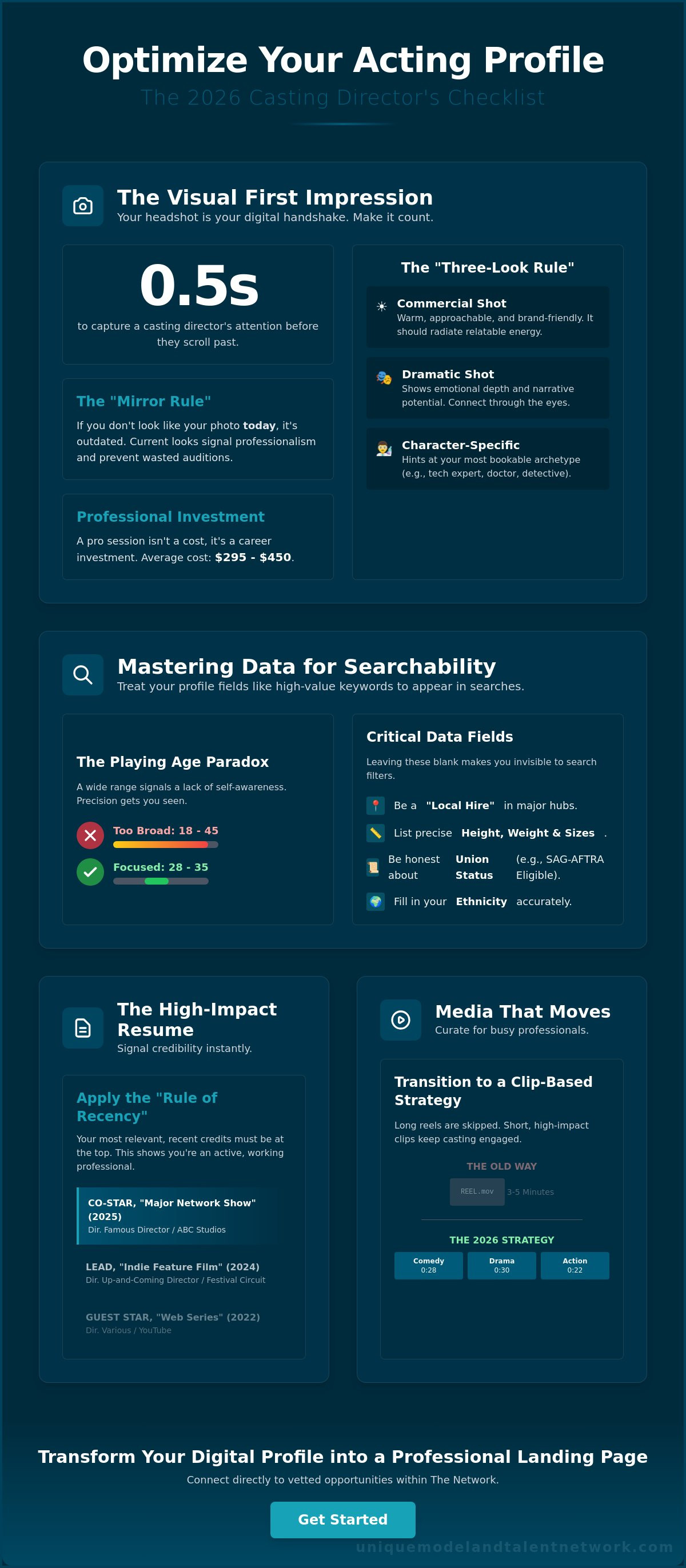
- Learn how to master the "Three-Look Rule" to ensure your primary thumbnail stops the scroll and communicates your professional range in under half a second.
- Discover how to optimize your acting profile for casting directors by treating data fields like playing age and physical attributes as high-value search keywords.
- Apply the "Rule of Recency" to your resume formatting to instantly signal credibility and ensure your most relevant work is seen first.
- Transition to a clip-based profile strategy that prioritizes 30-second scenes over long reels to keep busy industry professionals engaged.
- Understand how to transform your digital profile into a professional landing page that connects you directly to vetted opportunities within The Network.
The Visual First Impression: Optimizing Headshots for Digital Scanning
Casting directors often view hundreds of profiles in a single sitting. They aren't looking at your full resume initially; they are scanning a grid of thumbnails. You have exactly 0.5 seconds to capture their attention before they scroll past. Understanding how to optimize your acting profile for casting directors begins with the realization that your face is a digital product. If your primary thumbnail is cluttered, poorly lit, or amateurish, you've already lost the role before they even see your credits. High-quality imagery signals that you are a vetted professional who respects the industry's standards.
The "Three-Look Rule" is your strategic blueprint for a complete profile. You need a Commercial shot that radiates warmth, a Dramatic shot that shows emotional depth, and a Character-specific shot that hints at your most bookable archetype. While The role of an actor's headshot has always been to provide a likeness, the 2026 digital landscape requires it to communicate a specific story instantly. Don't fall into the "Selfie Trap." Even with advanced smartphone cameras, a selfie lacks the professional composition and lighting that separates hobbyists from serious talent. Investing the average $295 to $450 for a professional session is a non-negotiable step in building your career security.
The Thumbnail Test: Does Your Face Pop?
Open your profile and shrink your headshot to a 100x100 pixel square. If your features aren't distinct or your eyes don't draw the viewer in, the photo is failing. Successful digital headshots require "active thought" behind the eyes and direct eye contact to create a connection through the screen. For 2026, a theatrical headshot emphasizes emotional depth and dramatic potential for narrative storytelling, whereas a commercial headshot prioritizes approachable energy and brand-friendly relatability. When you master how to optimize your acting profile for casting directors, you ensure every pixel works to stop the scroll.
Photo Maintenance and Current Looks
Adopt the "Mirror Rule" to maintain your professional integrity. If you walk into a room and don't look exactly like your photo today, that photo belongs in the trash. Casting directors feel misled when a performer arrives with a different hair color, significant weight change, or visible aging not reflected online. It's better to have two current, high-quality photos than ten outdated ones. While you might be tempted to use "stills" from a recent set, these should stay in your gallery. Set stills often have distracting backgrounds or lighting that doesn't focus on your face, making them secondary to a clean, professional headshot.
Mastering the Data Fields: Searchability and Playing Age SEO
Casting directors operate like power users on a search engine. When they need a 6'2" athletic male with a 42R jacket size, they aren't scrolling through every profile on the platform. They are applying strict filters to narrow thousands of actors down to a manageable twenty. If you want to know how to optimize your acting profile for casting directors, you must treat your height, weight, and ethnicity fields as high-priority keywords. Leaving these blank or providing approximate data ensures you remain invisible during the initial search phase.
The Playing Age Paradox is where many actors stumble. You might think claiming a range of 18 to 45 increases your chances, but it actually signals a lack of professional self-awareness. In 2026, casting directors prioritize believability over versatility during the filtering stage. A focused range, such as 28 to 35, tells a CD exactly where you fit in their story. This precision builds the vetted look that industry pros expect. If you are unsure of your current marketability, participating in Live Industry Workshops can help you pin down your most bookable age range.
Location and union status are the final gatekeepers. Production budgets are tighter than ever; being a Local Hire in hubs like New York or Miami is a massive advantage. If you are willing to work as a local, list it. Similarly, be honest about your union status. If you are SAG-AFTRA Eligible, list it clearly, but don't claim full membership until your dues are paid and your card is in hand. Misrepresenting your status is a fast way to lose the trust of the industry gatekeepers.
Strategic Playing Age Selection
Determining your sweet spot requires looking in the mirror, not at your birth certificate. Casting directors in 2026 use your headshot to verify the data you've entered. If your photo looks 35 but your profile says 22, the discrepancy creates immediate doubt about your professionalism. Your playing age should reflect the roles you can realistically walk onto a set and play today. This honesty is a key part of how to optimize your acting profile for casting directors because it prevents wasted auditions and builds long-term industry relationships.
Physical Specs and Wardrobe Sizes
Precise measurements are mandatory for costume-heavy productions and period pieces. If a production is renting a vintage 1940s suit, they need to know it will fit you before you arrive for the fitting. Update your sizes every six months to avoid the fitting room friction that frustrates wardrobe departments. Additionally, include your vehicle information if you own a car. Commercials and background casting often filter for specific car makes or colors to fill out a scene, providing an easy entry point for real, paying jobs without the noise of traditional social media.
The Actor’s Resume: Formatting Credits for Maximum Credibility
Your resume is the "proof of concept" for your digital brand. If your headshot is the hook, your credits are the close. To understand how to optimize your acting profile for casting directors, you must view your resume as a curated list of accomplishments rather than a diary of every job you've ever had. By applying the "Rule of Recency," you ensure your most relevant and professional work appears at the top. Casting directors scan resumes in a matter of seconds; they want to see that you are currently active and trusted by other professionals.
Organization is key to establishing a "vetted" status. Use a clear Categorization Strategy by separating your work into distinct sections: Film, Television, Commercial, and Theater. If you are just starting out, student films and independent projects are valuable, but they should be grouped clearly under an "Independent/Student Film" heading. As you gain more professional credits on The Best Casting Websites in 2026, you can begin to phase out early student work to keep the focus on high-tier productions.
Training and Education as "Credit Substitutes"
If your resume is light on professional credits, your training section becomes your primary selling point. Listing prestigious acting workshops online demonstrates a commitment to your craft and shows that you are actively developing your skills. When listing teachers or directors, only name those with recognized industry standing to signal your connections. Your "Special Skills" section should be equally disciplined. Only list skills you can perform at a professional level on camera today. If you haven't ridden a horse since 2018, don't list "Horseback Riding" as a skill.
Resume Layout for Digital Reading
Digital readability is the cornerstone of how to optimize your acting profile for casting directors in 2026. Less is always more. Avoid cluttered layouts that force a CD to squint or hunt for information. Use standard fonts like Arial or Helvetica and prioritize white space to let the information breathe. Accurately labeling roles is non-negotiable; labeling a "Co-Star" role as a "Guest Star" is a major red flag that can damage your reputation instantly. A clean, honest resume reflects a professional who understands the business side of acting.
Media that Moves: Curating Reels and Self-Tapes for 2026
If you are still using a three-minute montage as your primary reel, you are likely losing the room before you even speak. In 2026, casting directors (CDs) have moved away from long, cinematic introductions. They prioritize the "60-Second Rule," which means they often stop watching a video after the first minute if they haven't seen a clear performance. Understanding how to optimize your acting profile for casting directors requires a shift from the traditional "demo reel" toward a "clip-based" profile. Individual 30-second scenes allow a CD to click exactly what they need to see; whether that is your dramatic range or your comedic timing; without wasting their time on a long edit.
High-quality self-tapes have become the new industry standard for vetting talent. If you don't have high-budget production footage yet, a well-executed self-tape acts as a perfect substitute. It demonstrates your professional discipline and technical literacy. Ensure your tapes are shot in 1080p with clear audio and a neutral background. This focus on "real, paying jobs" over vanity projects is what separates successful actors from the noise. If your current media feels unorganized, our Portfolio & Reel Reviews can provide the professional feedback you need to stand out.
The Anatomy of a Winning Clip
Your clips must start with your face and voice immediately. Avoid long, artistic montages or title cards that eat up valuable seconds. Choose scenes that highlight your specific "type" or brand so the CD knows exactly how to cast you. Technical standards in 2026 are higher than ever. If your audio is muffled or your lighting is flat, the CD will assume your on-set professionalism is equally lacking. Stick to 1080p video as a minimum and ensure your audio is crisp and free of background hum.
Slate Shots and Personality Clips
A "Slate Shot" is a powerful tool to show your natural personality and energy. This is a brief, seven-second clip where you simply state your name and height. It allows the CD to see the "real you" before they see the character. Keeping your media folders organized and labeled is part of the "without the noise" approach that professionals value. For a deeper dive into the technical side of managing your media, check out our Actors Access 101 guide. Mastering how to optimize your acting profile for casting directors means making their job as easy as possible by providing curated, high-quality content that is ready to view.
Beyond the Profile: Integrating Your Digital Presence with The Network
A static profile on a public casting site is only the first step. If you want to transform your digital presence into a career-building engine, you must view your profile as a high-conversion landing page for direct casting calls. Many actors make the mistake of setting up their page and waiting for the phone to ring. In May 2026, the industry is too competitive for passive strategies. Learning how to optimize your acting profile for casting directors is about more than just data entry; it is about signaling your reliability through professional association and consistent activity.
The power of "The Network Membership" lies in its ability to place your optimized profile in front of professionals who value vetted talent. When you move away from the chaos of social media DMs and into a curated environment, you immediately elevate your status. Casting directors are more likely to trust a performer who has invested in their professional development through Monthly Skill-Building Challenges and Industry Expert Q&A Sessions. This association acts as a badge of legitimacy, telling the industry you are serious about the business of acting and ready for the demands of a professional set.
The "Vetted" Advantage
Private networks bridge the gap between being unrepresented and being a professional. If you don't have an agent, joining a curated industry hub allows you to bypass the noise of public sites where thousands of hobbyists compete for the same roles. Use the feedback from your Portfolio & Reel Reviews to refine your marketing angle. This targeted approach ensures that when a CD views your page, they see a performer who has already been through a professional filter. You stop being just another face in the crowd and start being the definitive solution to their casting problem.
Your digital presence requires consistent upkeep to remain effective. Implement a "First of the Month" profile audit to ensure your data remains accurate. Check your playing age, update your wardrobe sizes, and swap out any media clips that no longer reflect your current look. This disciplined maintenance schedule prevents the fitting room friction mentioned earlier and keeps your profile at the top of algorithmic search results. Mastering how to optimize your acting profile for casting directors requires more than a one-time setup; it requires a commitment to professional excellence.
Final Checklist: Before You Hit Submit
Before you consider your profile finished, perform a final technical sweep. Broken links are the fastest way to look like an amateur. Do your social media and IMDb links actually work? Is your contact information current, whether it's for your personal email or a professional representative? Double-check that every field is filled to maximize your searchability within the database. If you are ready to stop guessing and start being seen for real, paying jobs, Join the Unique Model & Talent Network today.
Take Control of Your Professional Narrative
Mastering how to optimize your acting profile for casting directors is the definitive step toward career security in 2026. You now understand that your profile must function as a high-speed landing page; one that captures attention through authentic thumbnails and precise, search-optimized data fields. By applying the "Rule of Recency" to your credits and prioritizing 30-second clips over long reels, you present yourself as a vetted professional who respects the casting director's time.
A great profile is most effective when it is backed by a powerful community. You deserve a professional hub where you can access monthly skill-building challenges and receive feedback from vetted industry experts without the noise of traditional social media. Our network provides the practical guidance and meaningful relationships needed to move beyond the digital grid and into the audition room. Stop guessing and start booking; join the Network today! We are here to advocate for your growth and help you secure the real, paying jobs you have been working toward. Your professional evolution starts now.
Frequently Asked Questions
How often should I update my acting profile?
You should refresh your profile whenever you change your physical appearance or gain a significant new credit. Even if your look remains the same, a comprehensive update every three months ensures your profile stays active in search algorithms. This consistent maintenance signals to the industry that you are a disciplined professional who is actively pursuing work. It prevents the frustration of being called in for a look you no longer represent on set.
Do I really need a professional showreel to get noticed by casting directors?
You don't need a high-budget sizzle reel to capture attention, but you do need high-quality footage. Individual self-tapes shot with professional lighting and audio are often preferred over long, outdated reels. If you're learning how to optimize your acting profile for casting directors, prioritize 30-second clips that highlight your most bookable archetypes. This allows professionals to see your craft immediately without the noise of a three-minute montage.
Can I use a high-quality self-tape as my headshot or reel?
A high-quality self-tape is an excellent reel substitute, but it can never replace a professional headshot. Your headshot is a static marketing tool used for initial filtering, while your video media provides proof of your performance ability. Using a video still as a primary photo looks amateurish and often fails the thumbnail test. Keep these two assets distinct to maintain your vetted status and professional credibility.
What special skills are actually valuable to casting directors?
The most valuable special skills are those that can be verified and performed safely on set, such as stunt work, dialects, or professional driving. Avoid listing soft skills like "good with kids" or "fast learner" that cannot be easily categorized in a search filter. Focus on skills that provide a logistical advantage to the production. These specific talents often serve as the tie-breaker when a casting director is choosing between two similar actors.
Should I include my actual age or just my playing age on my profile?
Prioritize your playing age for marketing purposes, but keep your actual age available for legal and payroll requirements. A believable playing age range usually spans five years on either side of your current look. Being honest about your range builds trust with industry gatekeepers. If your profile claims a range that is too broad, it can dilute your brand and lead to fewer audition invites from serious productions.
How do I list credits if I have only done student films or community theater?
List student films and community theater under clearly labeled headings like "Independent Film" or "Regional Theater." Focus on the quality of the training you received and the specific roles you played rather than the size of the production budget. If you are unrepresented, your training section acts as a critical signal of your professional discipline. Mentioning highly accredited workshops shows you are a serious talent who is ready for professional sets.
What is the most common mistake actors make on industry casting platforms?
The most common mistake on industry casting platforms is failing to fill out physical specs or leaving the skills section empty. Casting directors use these fields as primary filters; if you haven't listed your height or jacket size, you won't appear in their search results. Another frequent error is using an unprofessional email address or failing to link a current IMDb page. These small details are essential components of how to optimize your acting profile for casting directors.
How can I get my profile vetted if I don’t have an agent yet?
You can get your profile vetted by joining a curated community like the Unique Model & Talent Network. This association provides a safe haven where you can receive portfolio reviews and self-tape feedback from seasoned coaches. By participating in monthly skill-building challenges, you demonstrate a level of commitment that signals reliability to the industry. It is a strategic way to bridge the gap between emerging talent and established professionals.


